94% of US restaurant sites have no menu markup
We checked the structured data on 190 US restaurant websites across eight cities. 94% carry no menu markup on either the homepage or the menu page, 91% never declare that they are a restaurant rather than a generic business, and 22% emit no structured data at all. Eleven sites in the sample do it properly. We ran the audit twice, at 124 sites and at 190, and the headline figures did not move.
What we did
Published restaurant guides covering Atlanta, Austin, Chicago, Dallas, Los Angeles, New Orleans, New York and Seattle. Eleven guides resolved; fifteen more returned 404 and were skipped, which the harvester records rather than hides.
Every outbound domain was extracted, then publishers, directories, ordering platforms, social networks, asset hosts and ad-tech removed. That left 213 candidate restaurant domains, of which 190 responded on 31 October 2026.
Each site had its homepage fetched and every JSON-LD block parsed. Where the homepage linked to a menu page, that page was fetched too, so no restaurant was marked down for keeping its menu markup where it belongs.
What we found
| Finding | Sites | Share |
|---|---|---|
| No menu markup, homepage or menu page | 179/190 | 94% |
| No FAQ markup | 188/190 | 99% |
| No opening hours as structured data | 175/190 | 92% |
| Never declares itself a restaurant | 173/190 | 91% |
| No breadcrumb markup on the homepage | 169/190 | 89% |
| No booking or ordering action declared | 151/190 | 79% |
| No stable identifier on the business | 146/190 | 77% |
| Describes a business, but only generically | 98/190 | 52% |
| No business entity described at all | 75/190 | 39% |
| No structured data whatsoever | 41/190 | 22% |
| Claims an aggregate rating | 5/190 | 3% |
| Broken, unparseable markup | 0/190 | 0% |
The numbers did not move when the sample grew
We ran this twice. The first pass covered 124 sites from five cities. The second covered 190 from eight, with a corrected business-type test and a cleaned sample.
94% and 91% both times. A figure that survives a 53% increase in sample size and a change of cities is measuring something real about how restaurant websites get built, not an artefact of which guides we happened to pick.
The menu number is the one that matters
A restaurant’s menu is the most valuable content it owns. It is what people search for, what they compare, and what an assistant needs in order to recommend the place to someone asking where to eat nearby.
In this sample, 94% of it is unreadable by machine. Not missing - the menus are all there, as photographs, as PDFs, as beautifully typeset HTML with no markup attached. Readable by people, opaque to everything else.
Eleven sites out of 190 did it properly. The best of them declares Restaurant on the homepage
and Restaurant plus Menu on the menu page, which is what the whole sample should look like.
Another emits nothing at all on its homepage and Restaurant, Menu and FAQPage on its menu
page - which is why following the menu link mattered, and why a study that judged homepages alone
would have reached the wrong answer about it.
Nine in ten never say what they are
173 of 190 sites never declare that they are a restaurant. 75 describe no business entity at all,
and a further 98 describe one only as a generic Organization or LocalBusiness - a description
equally true of a dentist, a law firm and a scrapyard.
Schema.org has had a Restaurant type for over a decade. It inherits everything the generic types
carry and costs nothing to use. The local business schema
guide covers why the specific type is always the right
call.
What almost nobody gets wrong
Two findings cut the other way, and they are worth stating because they contradict the usual agency pitch.
Nothing was broken. Zero sites had an unparseable JSON-LD block. When these restaurants emit structured data, it is valid. The problem is omission, not malformation, and anyone selling you a “fix your broken schema” audit is solving a problem this population does not have.
Almost nobody is faking reviews. Five sites claimed an aggregate rating. Fabricated ratings are the one structured-data mistake that attracts a manual penalty, and this population is not making it.
No restaurant is named here
Not the ones that failed, and not the eleven that got it right. These are small businesses that did not ask to be in a study, and a site whose entire argument is about doing this honestly should not build its credibility by listing other people’s mistakes under their trading names.
The aggregate is the finding. If you want to know how your own site does, run the audit against it
- the script is below and it takes a minute.
Limitations, stated plainly
The sample flatters the population. These restaurants were chosen because a publication wrote about them, which correlates with having a budget and someone competent building the site. A random sample of US restaurants would almost certainly be worse.
Homepage and menu page only. A site could carry excellent markup on a reservations or locations page and still be counted as failing the things we checked elsewhere.
One point in time. Measured 31 October 2026. Sites change.
Eight cities, not the country. Enough to say the pattern is overwhelming. Not enough to put a decimal point on it, which is why no figure here has one.
Hotels were attempted and abandoned. Eight of twelve hotel guides refused our requests, which left the sample dominated by one article whose outbound links were mostly its own publisher’s international editions and a pile of ad-tech. Roughly seven genuine hotels survived, all in a single city. The honest move was to drop the vertical rather than publish 100% of 30 when a third of that 30 were not hotels.
Reproduce it
Both scripts are in this site’s repository, along with the list of guides the sample was drawn from. The sample itself is not committed - it is a list of real businesses, and the point of the previous section is that we do not publish those. You regenerate it, which also means you are checking our harvesting rather than trusting it.
npm run harvest scripts/samples/guides-restaurants.txt restaurants \
  > scripts/samples/us-restaurants.txt
npm run audit scripts/samples/us-restaurants.txt
The audit refuses to print percentages from fewer than 30 reachable sites. That guard is aimed at exactly this kind of study: easy to run badly, and easy to publish a confident number from a sample that cannot carry one.
Running in production
Every technique on this page is live on a client site, not a demonstration written for the article.
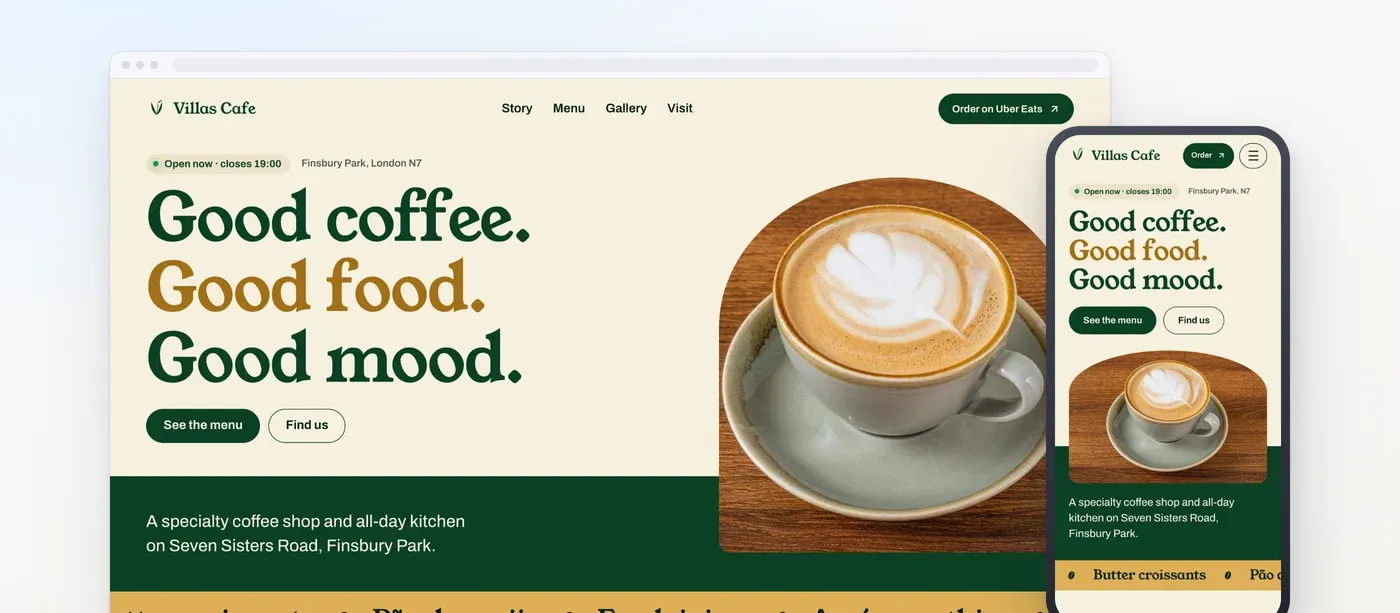
Cafe
Villas Cafe
Most cafe sites publish the menu as a picture or a PDF, which means no search engine can read a single dish or a single price…
Read the case study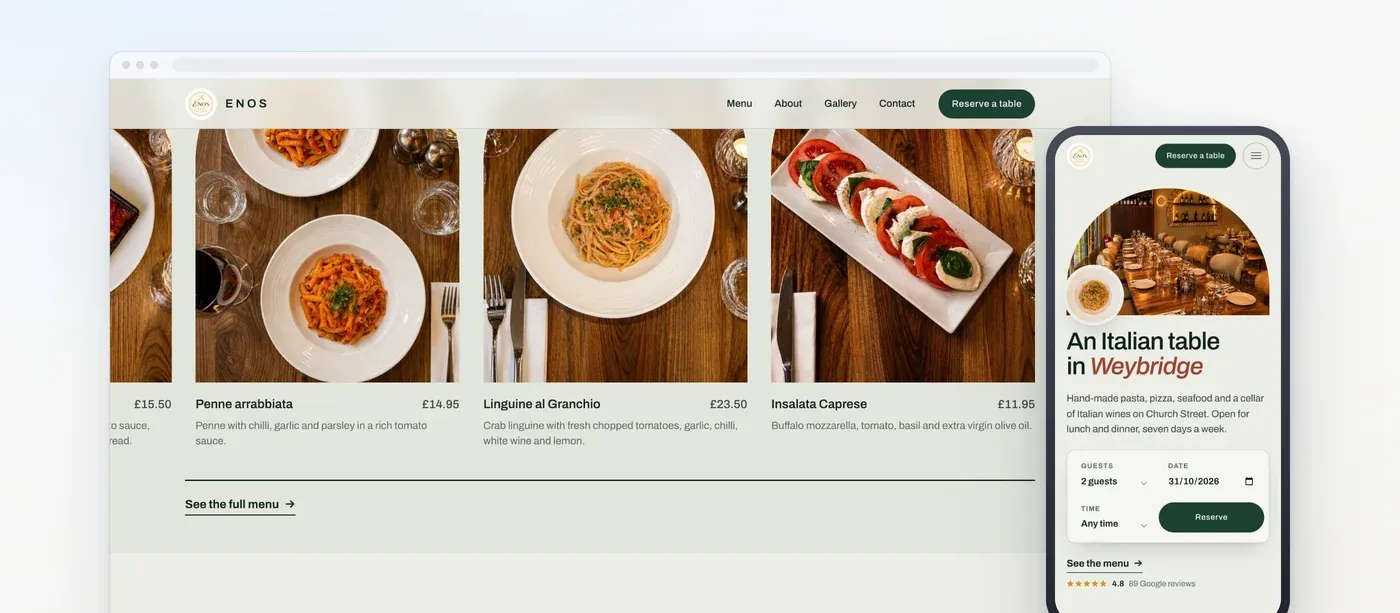
Restaurant
Enos Restaurant
Restaurant bookings usually arrive through a marketplace that charges per cover and owns the diner relationship. The restaurant…
Read the case studyQuestions we get asked
How was the sample chosen?
We took published restaurant guides covering eight US cities, extracted every outbound domain, and removed publishers, directories, ordering platforms, social networks and asset hosts. That left 213 candidate domains, of which 190 responded. The sample is biased towards restaurants good enough to be written about, which correlates with having a budget and a competent developer - so the true population is probably worse than this, not better.
How confident are you in these numbers?
More than we expected to be. We ran the whole thing twice on different samples, 124 sites and then 190, and the two headline figures came out identical both times: 94% with no menu markup, 91% never declaring themselves a restaurant. A pattern that stable across two independent draws is not a sampling accident.
Does any of this actually affect rankings?
Structured data is not a ranking factor the way a link is. What it does is make a page eligible for rich results and legible to assistants answering questions directly. The honest framing is that 94% of these restaurants cannot have their menu read accurately by a machine, and the share of people asking a machine rather than scrolling results goes up every year.
Can I reproduce this?
Yes, and you should rather than take our word for it. The harvesting and auditing scripts are both in this site’s repository, the guide list and the sample are committed beside them, and the whole run is two commands. Every figure on this page can be regenerated from scratch.
Did you try other sectors?
We tried hotels and abandoned it. Eight of the twelve hotel guides refused our requests, which left the sample dominated by a single article whose outbound links were mostly its own publisher’s international editions and ad-tech. About seven genuine hotels survived, all in one city. We would rather report a failed sampling frame than publish a percentage from that.
Tell us what you need built.
A short call, a straight answer on scope and cost, and a fixed quote. No retainer, no monthly fee, no commission on your orders.