Bookings that run on your own site
A booking or reservation path built into your own site, running on infrastructure you control rather than a marketplace that charges per cover and owns the guest relationship. The path is marked up as a ReserveAction so search engines and assistants can read it as something a visitor can actually do.
- No per-cover or per-booking fee to a marketplace
- The guest relationship and the data stay with you
- ReserveAction markup, so the booking path is machine-readable
- Runs on your own domain and your own infrastructure
PriceQuotedFull pricing
The cost is not only the commission
A marketplace booking costs you a percentage, which is the visible part. The less visible part is that the confirmation email, the reminder, the review request and the record of who stayed or ate and when all belong to the platform. Next time, they market to your guest.
A booking taken on your own site costs you nothing per cover and leaves all of that with you.
How it is built
For a restaurant, a small reservation API on your own infrastructure - Enos Restaurant runs one of its own - handling covers, time slots and confirmations. For a property with real inventory complexity, we integrate with the system you already run rather than rebuilding it worse.
Either way the booking path is marked up as a ReserveAction with a typed entry point and a
declared result, so the capability is machine-readable rather than hidden inside a form.
What we will not do
We will not build you a yield management system, a channel manager, or anything that syncs rates across a dozen OTAs. Those are products with teams behind them and the right move is to buy one.
Nor will we tell you to leave the marketplaces. They find you guests who had never heard of you. The argument is about the guest who already knows your name.
Where this is running
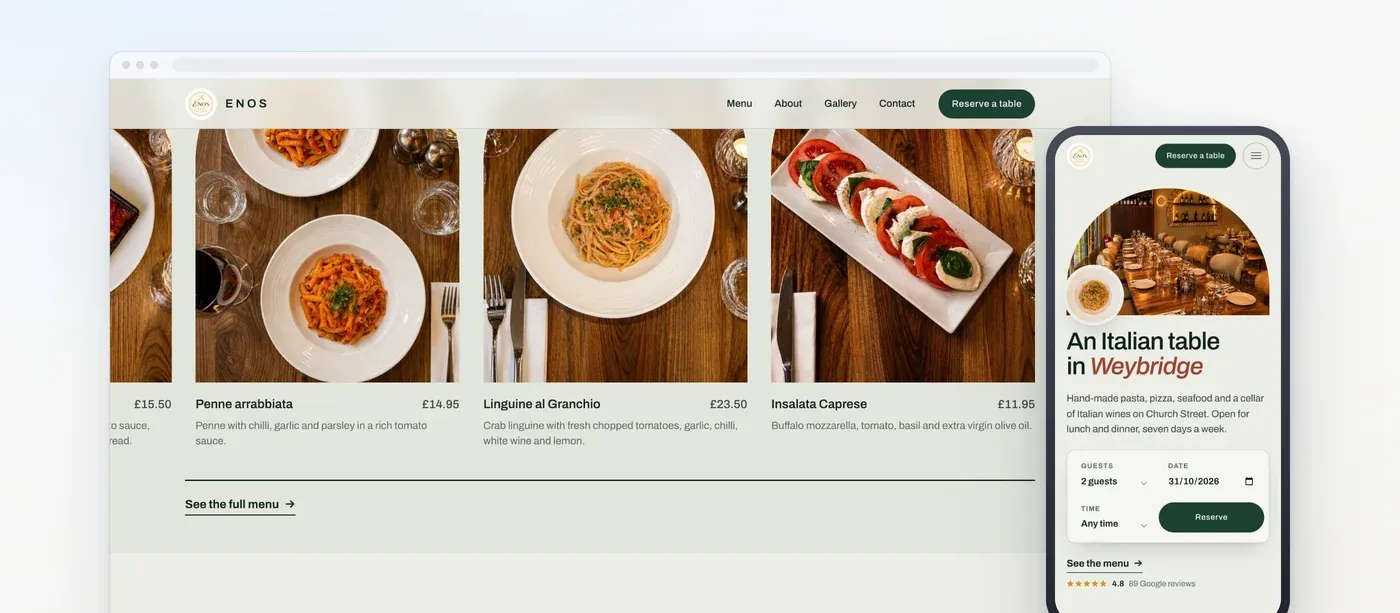
Restaurant
Enos Restaurant
Restaurant bookings usually arrive through a marketplace that charges per cover and owns the diner relationship. The restaurant…
Read the case study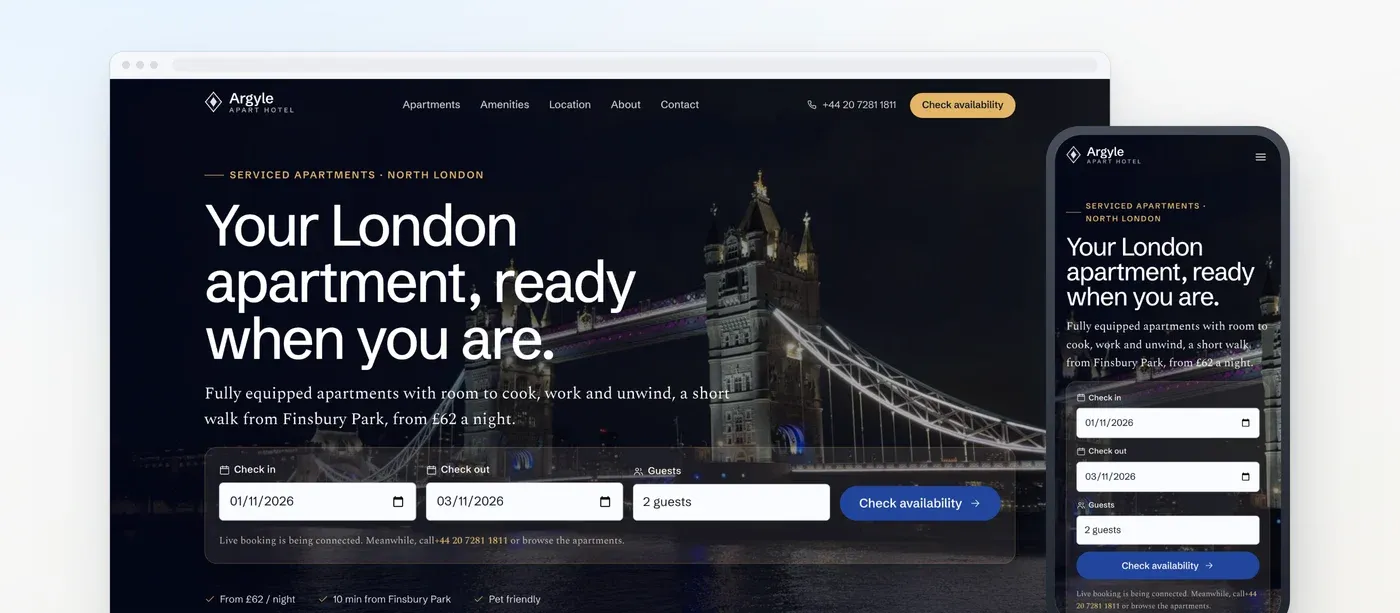
Hotel & short-stay
Argyle Apart Hotel
Serviced apartment operators compete for the same guest as the OTAs, on the OTAs' terms. Every room night booked through an…
Read the case studyBefore you enquire
What this is not.
Every service page should say where it stops. If one of these is what you need, we are the wrong call and would rather you knew now.
- Complex inventory: yield management, channel syncing across OTAs, or seasonal rate rules. That is a product, not a build.
- Replacing the OTAs entirely. They are a marketing channel as much as a booking one, and leaving them completely is rarely the right call.
Questions we get asked
Should I drop the OTAs and booking marketplaces?
Almost certainly not. They are a marketing channel that happens to take bookings, and for a property nobody has heard of they do real work. The goal is to stop paying a commission on the guest who searched for you by name and landed on a marketplace because it outranked you.
What about availability and calendars?
For a restaurant, a reservation API on your own infrastructure handles covers and time slots perfectly well. For a hotel with rates changing by season and inventory shared across channels, you want a dedicated system and we will integrate with it rather than rebuild it badly.
Will Google show a reserve button?
Not from markup alone. Those features largely run through partner integrations and no amount of correct JSON-LD enrols you in one. What the markup does is make the capability legible to assistants answering questions directly, which is a smaller audience today and a growing one.
Tell us what you need built.
A short call, a straight answer on scope and cost, and a fixed quote. No retainer, no monthly fee, no commission on your orders.